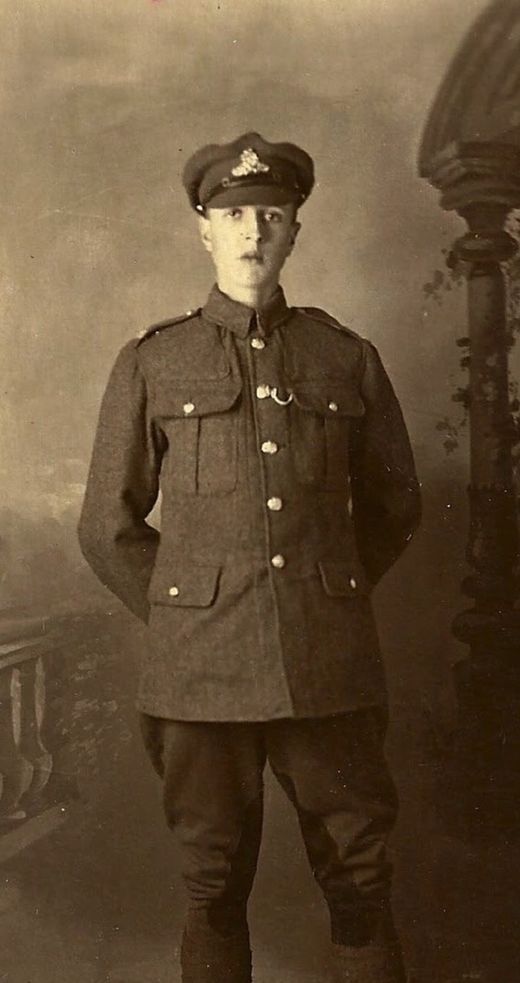
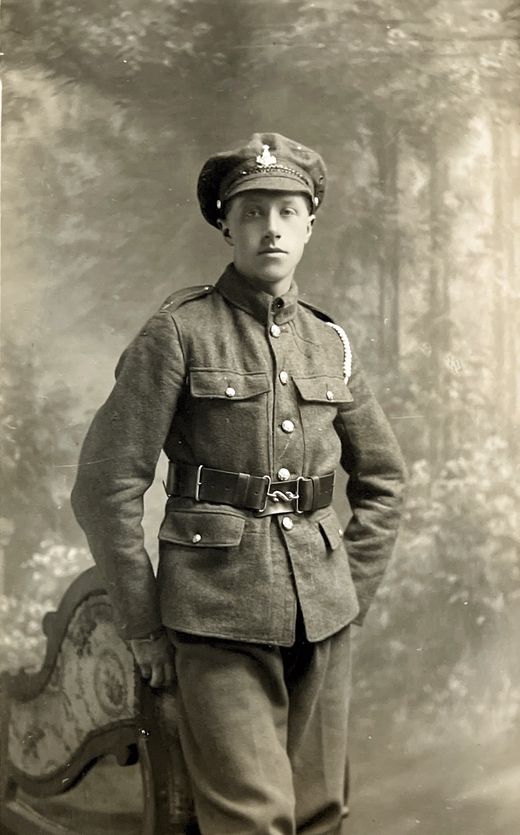
William Harry Critchlow lied about his age to join the artillery at fifteen. His cousin Gerald Critchlow Moreton waited until he was eighteen. Both left Bucknall for the same stretch of front. One came home.
Killed by a gas shell at Épehy, Christmas Eve 1917
Follow them across the map
Front line on this datePrevious front lineWilliamGeraldRoute in the recordsTypical route of the dayInferred7th Leicesters’ march, Nov 1917
Date
—
The records, read again
What William’s service papers actually say
The family story, and my earlier post, had William at the Somme from the first day to the Armistice: “nearly 3.5 years of trench warfare”. Reading his surviving service papers line by line tells a different, and in some ways more remarkable, story. They are badly burnt (most First World War service records were lost in the 1940 bombing of the War Office store in Arnside Street, and those that survived carry the scorch marks), but the key entries are legible.
He attested at Hanley on 1 November 1915 as a Driver in the 3/2nd North Midland Brigade, Royal Field Artillery, a Territorial unit, giving 170 High Street, Bucknall, as his mother’s address so that the letter from the War Office would not reach 4 Baker Street. He also signed the Imperial Service obligation that same day, agreeing to serve overseas. He was fifteen and a half. His Territorial regimental number was 1734; in the 1917 renumbering of the Territorial Force he was given a six-digit number beginning 820,23…, the same series as other Section I men named in the column’s diary (Gnr J. Stanley, 820400, who won the Military Medal at Bracquemont).
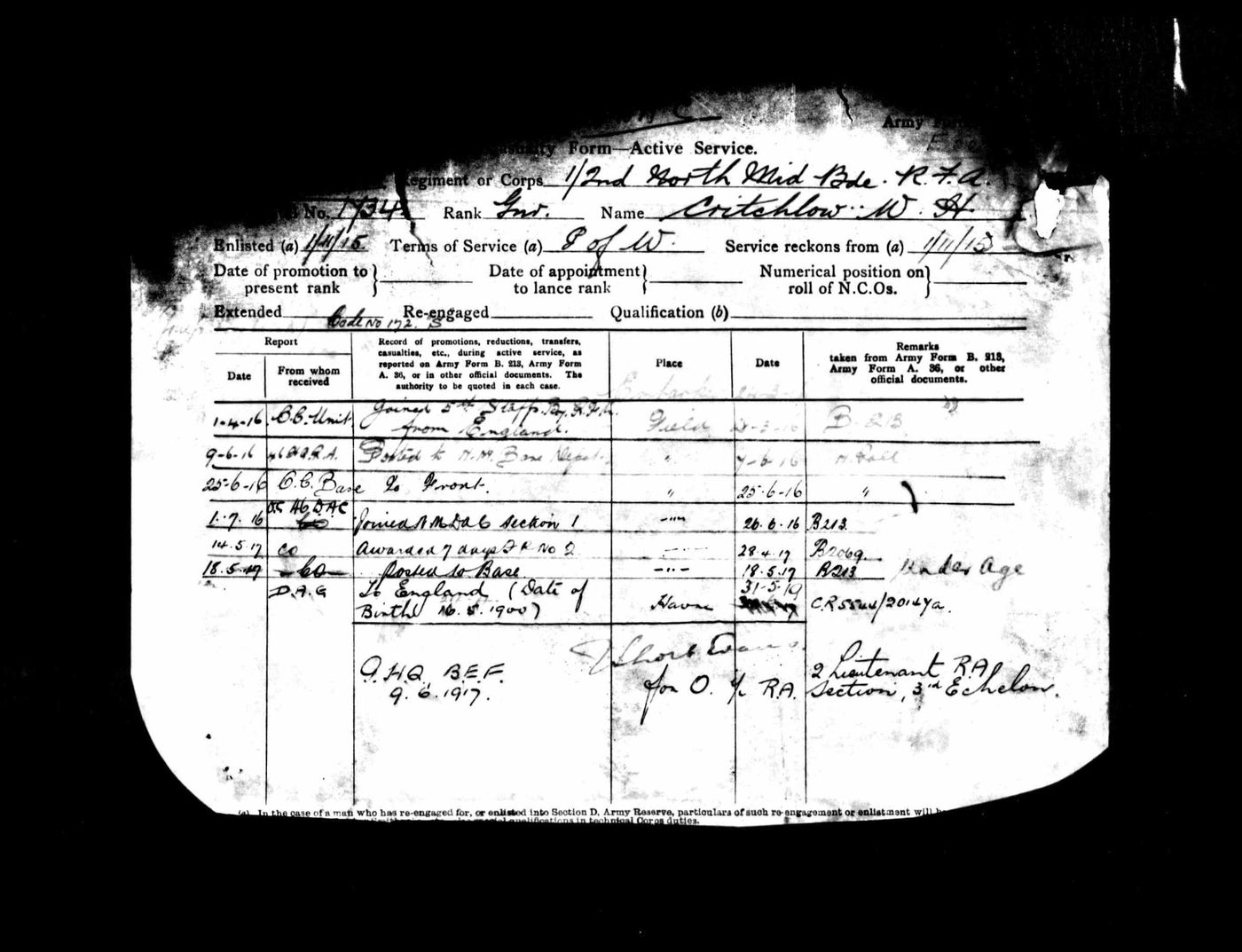
Casualty Form – Active Service (Army Form B.103), 1/2nd North Midland Brigade RFA. The pivotal line is near the bottom: “Posted to Base … Under Age”.
Report
Entry
Place
Date
Authority
—
Embarked
24·3·16
1·4·16
Joined 5th Staffs Bty RFA from England
Field
28·3·16
B.213
9·6·16
Posted to N.M. Base Depot
″
7·6·16
N. Roll
25·6·16
Base to Front
″
25·6·16
″
1·7·16
Joined N.M. D.A.C. Section 1
—
26·6·16
B.213
14·5·17
Awarded 7 days F.P. No 2
—
28·4·17
B.2069
18·5·17
Posted to Base
—
18·5·17
B.213 · Under Age
—
To England (Date of Birth 16·5·1900)
Havre
31·5·1?
CR 5544/2014
So the date “1 July 1916” that the family remembered is real, but it is the day the paperwork reported his arrival at the 46th (North Midland) Divisional Ammunition Column, which he had joined on 26 June, five days before the attack at Gommecourt. He had in fact landed in France three months earlier, on , and gone straight to the 5th Staffordshire Battery of the 1/3rd North Midland Brigade, a West Bromwich battery, then in action below Vimy Ridge.
Getting there, March 1916
Southampton, Le Havre and the cattle trucks
No letter or diary of William’s own survives, so the journey has to be pieced together from the way every artillery draft travelled, and from the ammunition column’s own account of its crossing a year earlier. A draft of gunners went by train from its reserve brigade to Southampton, most likely by the Great Western line through Birmingham, Oxford and Reading, which kept troop trains out of London. The column’s diary describes the waiting: two nights aboard ship at the quay, stables at 6.20 a.m., foot drill on the quayside, “No officer or man allowed off ship after 4.30 p.m. Lights out 9.15 p.m.”, then an evening sailing and arrival at Le Havre at 10.30 the next morning.
From the docks, gunner reinforcements marched up to the RFA base depot camp above Harfleur, and then went up the line in a troop train of goods vans stencilled Hommes 40, Chevaux 8: up the Seine to Rouen, across to Amiens and north towards St-Pol, a day and a half of stops and starts. The column’s diary grumbles that its own stops “were in most cases too short for watering to be properly carried out”. From the railhead it was on foot, or on the tail of a wagon, to the battery. The brigade’s diary for 27 March records the moment: “93 O.Rs reinforcements came up from Base”. William joined his battery “in the field” the next day, a month short of his sixteenth birthday.
March – June 1916
Vimy Ridge, then Gommecourt
The 1/3rd North Midland Brigade’s guns were dug in east of Mont-St-Éloy, below Vimy Ridge, in a sector taken over from the French only that month. The brigade formed the “Centre Group” covering the 139th (Sherwood Foresters) Brigade. As a driver, William lived at the wagon lines at Camblain-l’Abbé, two miles back, and took the teams up at night. This was a sector of mine warfare. On 25 March the Germans blew a mine and seized the crater. For the next two days “all batteries” fired salvoes into it “every 15 minutes”, and the infantry took its western lip back at 1.30 a.m. on the 27th, the day William’s draft arrived.
On the diary records “the 4th & 5th Batteries were shelled from 2.30 pm to 3.30 pm – 4 men were killed and two wounded”. One of the wounded, Corporal Moore, died in hospital the next day. These were William’s battery’s first heavy losses since he arrived. After a few days’ rest at Gouy-en-Ternois the brigade marched south to Warlincourt on 7 May. All that month it dug shell-proof gun pits behind Foncquevillers, “14 feet below the ground”, carting timber and cement up at night from the dump at Mondicourt. On 20 May the brigade was renumbered 232nd Brigade RFA, and the 5th Staffordshire Battery became “B” (South Staffs) Battery.
Then on 3 June the divisional commander and the veterinary officer inspected B Battery’s horses for mange. They ordered the horses isolated, the nosebags, hay-nets, grooming kit and blankets destroyed, “all Horses and Harness to be washed thoroughly and men to be disinfected”. The disinfection was finished on 7 June, the same day William was posted to the base depot. The papers do not link the two. It may only be coincidence, or a consequence of the ammunition columns being merged two weeks earlier, which left the brigade with spare drivers.
June 1916 – May 1917
Driver Critchlow and the ammunition column
On 22 May 1916 the brigade ammunition columns had been merged into one Divisional Ammunition Column. William was sent back to the North Midland Base Depot “by nominal roll” on 7 June, and nothing on the form suggests a wound or a hospital. On 25 June he came “Base to Front”, and the next day the column’s diary, at Gaudiempré, records “40 Reinforcements received from N.M. Base Depot. 30 to D.A.C.” This is almost certainly William’s draft. He was posted to No. 1 Section, billeted at Grincourt-lès-Pas, five miles behind the Gommecourt salient.
The column was the supply chain for the guns. Its drivers rode the near-side horses of six-horse teams hauling limbers and General Service wagons of 18-pounder shells from the dumps at Gaudiempré and Saulty up to the batteries behind Foncquevillers, mostly at night, along roads the German gunners knew. In the last week of June the diary counts “an average of 80 teams daily (up to 120 at most)”, and on 25 and 29 June drivers were wounded and mules killed “whilst delivering ammunition”. Every shell of the bombardment before came up this way. The attack itself, a diversion for the main Somme offensive further south, failed badly: the 46th Division lost some 2,400 men in a day, and the line at Gommecourt did not move.
The diary then lets us follow Section 1 almost week by week. It moved to Saulty on 4 July. On 31 July it went to Le Gros Tison Farm, a farm hamlet outside Lucheux near Doullens, “for the purpose of providing personnel + horses for the R.A. Training School”, a month out of the line. Autumn was spent at Saulty on harness fitting and “horsemastership”, with remounts arriving from Dieppe. December was spent in the training area at Milly, near Doullens, where “all horses were in the open in deep mud”. On 20 December the column went back into the line with the A Echelon at Henu. That winter brought rain, then snow and very hard frost, the oat ration cut from 12 lb to 9 lb a horse, and mange spreading through the lines.
February 1917 was the great haul: 70, 94, 97, then 116 wagons a day carried ammunition to the battery positions. When the Germans began to pull back in March, the ground was too broken for wheels and shells went up “by pack animals”, one man leading two, to Biez Wood and Sailly-au-Bois. The 46th walked into the ruins of Gommecourt on , eight months after failing to take it.
Then came the march north, about 60 miles in a fortnight: Le Meillard on 29 March, Boubers-sur-Canche, Anvin, a rest at Fontes, then the L’Eclème–Robecq road. Water was carried in petrol tins on the wagons so that every horse could be watered on the road. On Section I went into the line among the pit-heads at the Fosse dite de Bracquemont, near Noeux-les-Mines, behind Lens. On 6 May six of the column’s men and eight mules were wounded by shell fire, and the next day Section I moved to billets at Houchin.
28 April – 18 May 1917
Field punishment, then “Under Age”
On , at Bracquemont, William committed an offence for which, on 14 May at Houchin, he was awarded seven days’ Field Punishment No. 2 (Army Form B.2069): extra fatigues and confinement in fetters, but without being tied to a fixed object as in the notorious No. 1. The charge sheet does not survive. Four days later, on , he was “Posted to Base”, with Under Age written in the remarks column. From Havre he was sent “To England (Date of Birth 16·5·1900)” on the authority of the Deputy Adjutant-General, file CR 5544/2014. By the army’s rules no soldier was to serve overseas under nineteen; he was seventeen years and three weeks.
Were the two connected? The papers do not say, but three clues point that way.
The delay. A commanding officer’s summary punishment was normally given within a day or two. Here sixteen days passed between offence and award, as if the case were held while something was looked into.
The timing. He was posted to base just four days after the award, from the same section, with the entry raised by the unit itself (Army Form B.213).
The wrong birthday. His age was evidently established in France, not from a certificate sent from home. Had his mother written to the War Office with his birth certificate, as many parents did, the record would show 24 April 1900. Instead it shows 16 May 1900, the kind of date a boy gives when he is finally asked.
A defaulter brought before his officer had his papers looked at, and a slight sixteen-year-old in front of a major is hard to miss. The likeliest reading is that the charge brought his age to light. It remains a reading, not a proven fact. The DAG file (CR 5544/2014) and his conduct sheet, if either survives, would settle it.
June 1917 – May 1919
The Irish Mail and Moore Park
That was not the end of his service. On he was posted, at Home, to 325 Brigade RFA (“4/325 Bde, Posted, Dr, Home, 21·6·17”). That brigade belonged to the 65th (2nd Lowland) Division, a second-line Scottish Territorial division sent to Ireland in January 1917, eight months after the Easter Rising, with its artillery at Kildare. A soldier for Ireland took the Irish Mail from Euston through Rugby, Crewe and Chester and along the North Wales coast to Holyhead. From there the City of Dublin Steam Packet Company’s mail boats, Leinster, Munster, Ulster and Connaught, crossed to Kingstown in about three hours, and the Great Southern & Western ran from Kingsbridge to Kildare.
It was a crossing he would remember. On , a month before the Armistice, the RMS Leinster was torpedoed by UB-123 just outside Dublin Bay, and more than 500 people died, most of them soldiers going on or coming back from leave. It remains the greatest loss of life in the Irish Sea.
The Ireland he arrived in was a year on from the Easter Rising and changing fast. Through 1917 Sinn Féin won one by-election after another, among them Éamon de Valera’s at East Clare in July, and the Scottish Territorials of the 65th Division, spread from Dublin to Galway, became a garrison that the country increasingly saw as an occupying force. The division was ordered to disband in January 1918 and closed its headquarters on 18 March. Around then his howitzer battery was renumbered 886 Battery and carried on under other command.
1918 brought crisis after crisis. In April, with the Germans breaking through in France, Parliament voted to extend conscription to Ireland. Nationalists, the Catholic bishops and the trade unions united against it, and on nationalist Ireland stopped work for a day. Conscription was never enforced, but in May most of the Sinn Féin leadership was arrested over an alleged “German Plot”. In October came the sinking of the Leinster, and with it the second and deadliest wave of the influenza pandemic. Kildare, with the packed barracks of the Curragh, was reported as the worst-hit county in Ireland. In the December general election Sinn Féin took 73 of the 105 Irish seats.
His last papers place the battery at Moore Park, Kilworth, a camp above the Blackwater near Fermoy in County Cork. It was reached by the Great Southern & Western via Limerick Junction and Mallow and the little branch line to Fermoy. Kilworth had been a training area since 1896, and the Moore Park estate was bought to enlarge it in 1903. On 21 January 1919 the new Sinn Féin MPs met in Dublin as Dáil Éireann, and the same day Volunteers shot dead two policemen at Soloheadbeg in Tipperary. That shooting is usually taken as the start of the War of Independence. The same month, Liam Lynch formed the IRA’s Cork No. 2 Brigade, with its headquarters in Fermoy itself and a company at Kilworth. Bill was serving in a camp whose neighbours were organising against it.
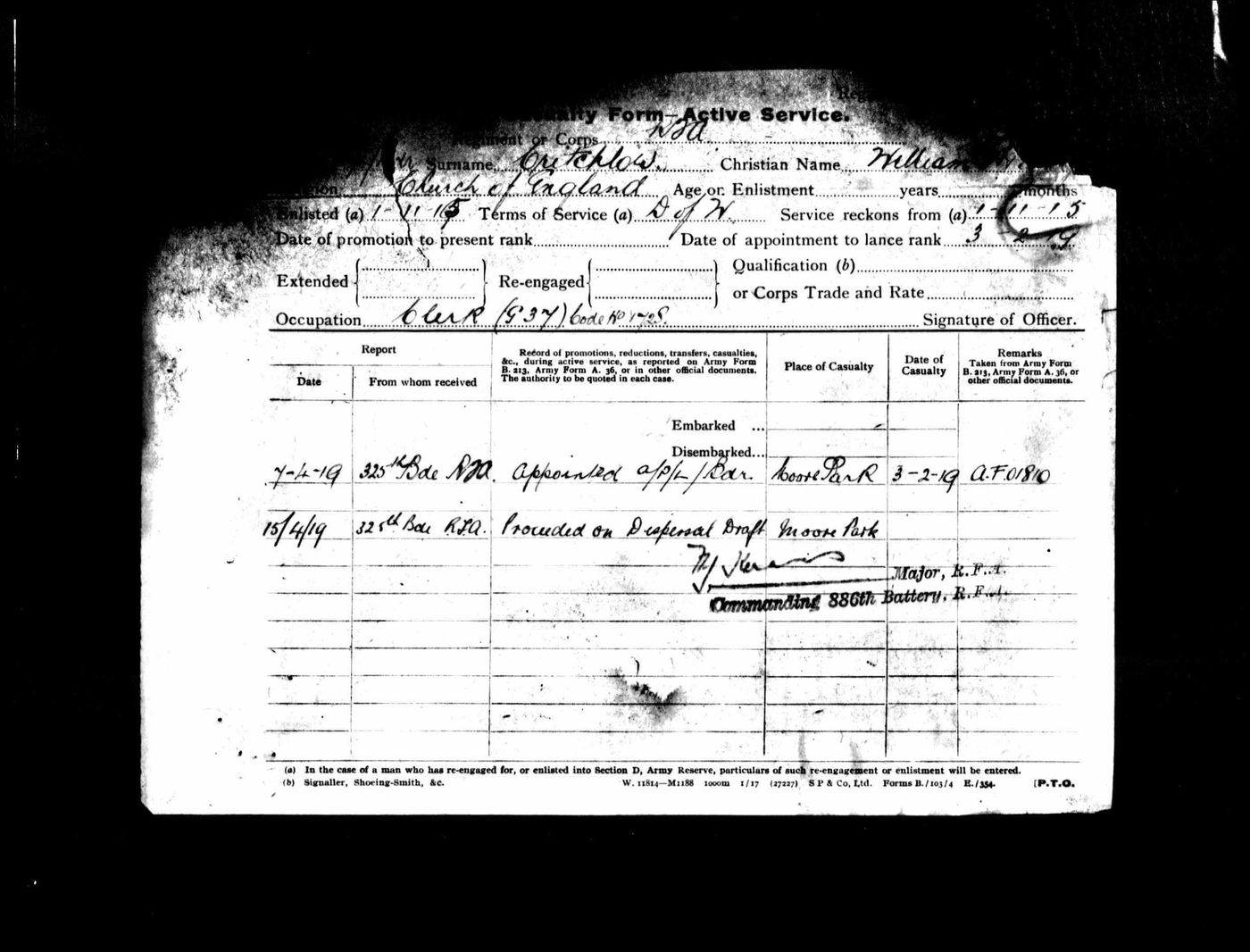
“Appointed A/P/L/Bdr, Moore Park, 3·2·19, A.F. O1810”: Acting Paid Lance-Bombardier, signed by the Major commanding 886th Battery RFA. On 15 April 1919 he “proceeded on dispersal draft”.
There, on , he was made an Acting Paid Lance-Bombardier, his first stripe. That spring the local Volunteers raided the police barracks at Araglin, a few miles from the camp, for arms. He left on a dispersal draft on , most likely by the mail boat from Kingstown to Holyhead and home through Crewe. Demobilised men were given 28 days’ furlough, and at the end of it, on 15 May 1919, the artillery records office at Charlton closed his papers: “Disembodied on Demobilization … Home Address Baker St, Bucknall”. He was nineteen years and three weeks old, and the following year he walked into Pratt’s oil depot at Cliff Vale as a junior clerk (see William Harry Critchlow (1900–1969)).
He got out just in time. On 7 September 1919, Lynch’s men ambushed a party of soldiers walking to the Wesleyan church in Fermoy to seize their rifles. One soldier was killed, in the first organised attack on British troops since 1916, and the following night soldiers from the garrison wrecked the town’s shops. In 1966 the Irish Army renamed the Kilworth camp Lynch Camp, after the man who had organised the IRA on its doorstep. None of this appears in Bill’s papers. A quiet garrison posting in a country sliding towards war was probably not something a man who had been to France thought of as “the war” at all.
12 November – 24 December 1917
Gerald’s forty-three days
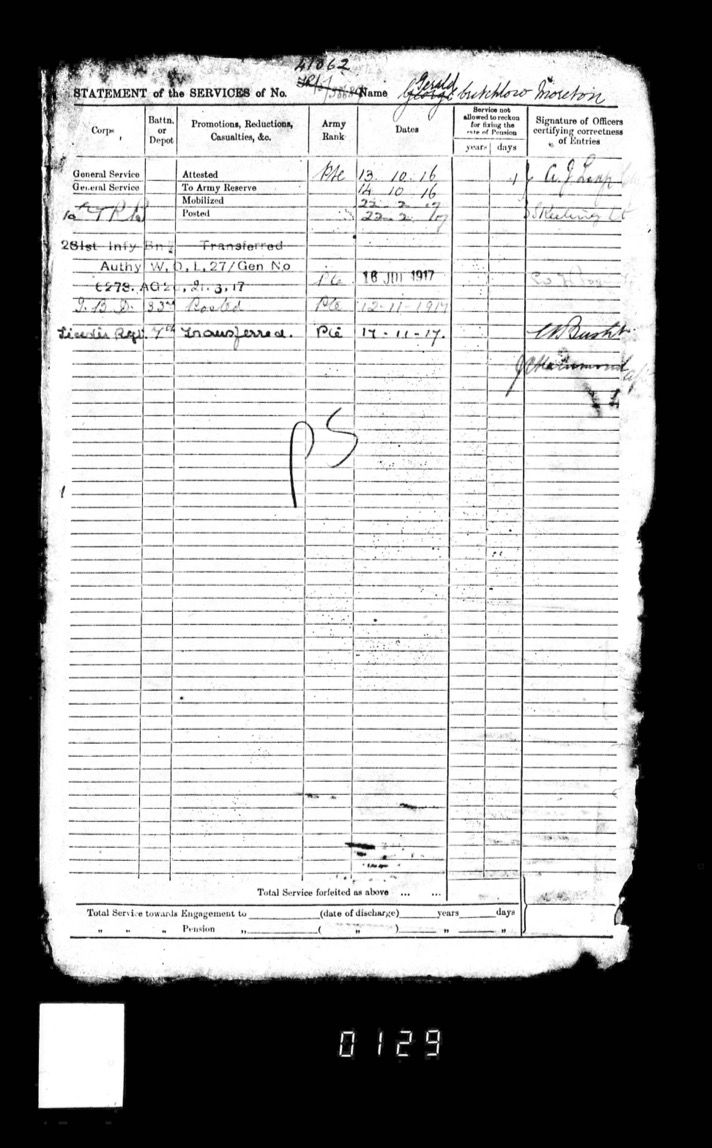
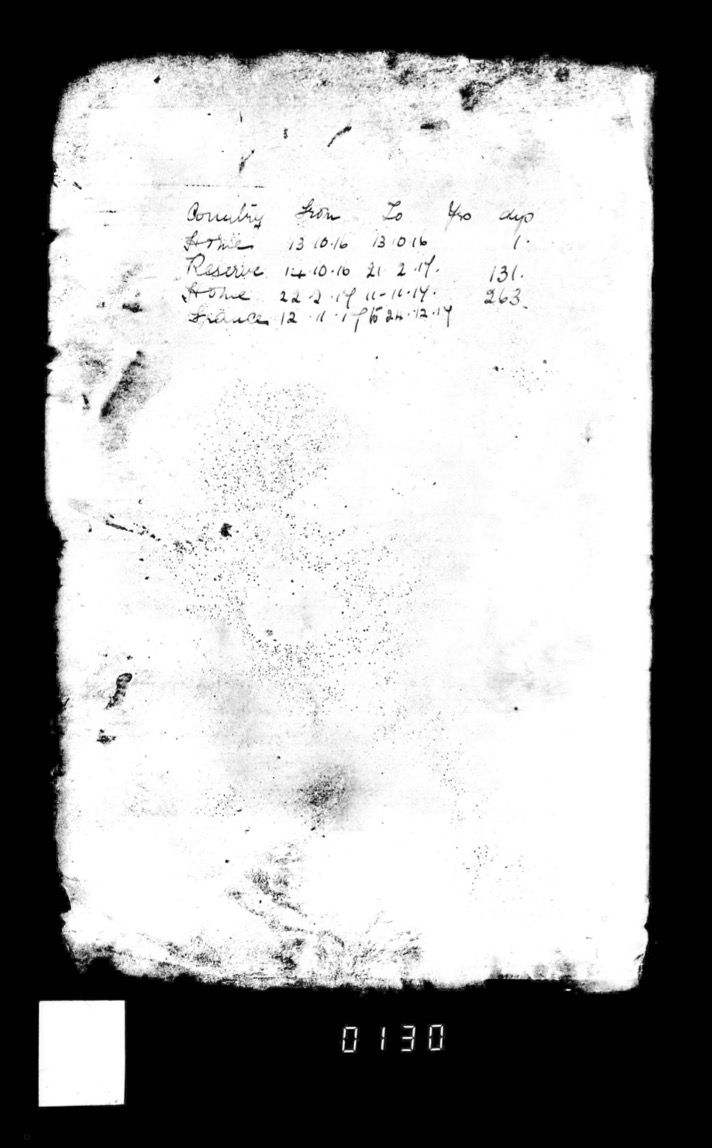
Gerald’s papers survive in better condition. He attested at Hanley on 13 October 1916, five days after his eighteenth birthday, giving his trade as cycle mechanic and his height as five feet five. His medical sheet, filled in at Stoke on 22 February 1917, records him as 5 ft 5 in and 113 lb, with perfect eyesight. The same day he was posted to the 10th Training Reserve Battalion at Rugeley, one of the two great hutted camps on Cannock Chase, fifteen miles from home. Nine months of drill, musketry and bayonet practice on the Chase followed, from July 1917 as the 261st Infantry Battalion, before he crossed to France on . The tally on the back of his service record is brutally exact: Home 263 days. France 12·11·17 to 24·12·17.
Statement of Services, No. 41062: Training Reserve, then 33rd Infantry Base Depot on 12 Nov 1917, then “Leicester Regt 7th, Transferred, 17·11·17”.Service by country. “France 12·11·17 to 24·12·17” has no day-count beside it.
Infantry drafts crossed from Folkestone to Boulogne and went down the coast to the base camps at Étaples, the 33rd Infantry Base Depot of his record. On 17 November he was transferred to the 7th Leicesters, the “Tigers”. That day the battalion was at Devonshire Camp, Reninghelst, just out of the Ypres salient after Passchendaele. The next morning it set off on a nine-day march south: Noote Boom by Locre and Bailleul, Caudescure, Gonnehem, then Coupigny, where on 22–24 November “A Draft of 40 Other Ranks joined the Battalion.” On the 25th it marched on to Frévillers, and the diary noted with pride that “During the period Nov 16th to 25th, no man fell out on the march.” Drafts of another 94 men arrived there over the next four days. Gerald was almost certainly in one of these two drafts.
At Frévillers the new men did bayonet fighting, physical training, musketry and arms drill, and “baths were provided for the men on the 27th”. Then the German counter-attack at Cambrai on the morning of 30 November changed everything. The brigade’s move to Italy was cancelled, and that evening “Battalion received urgent orders to move and entrained at Savy at 7.30 pm for Tincourt.” They spent the night in the train. Richardson’s history of the Tigers describes what followed for the brigade: two hours standing in pouring rain without greatcoats, the transport miles behind, while the staff sorted out the confusion and reconnoitred positions abandoned by a battered division. One officer found an artillery major lying dead in pink silk pyjamas in front of his battery. At 7 a.m. on they detrained at Tincourt and went to a camp at Courcelles. At 2 p.m. they were on the road again, through Buire, Tincourt and Longavesnes, with “a long halt for teas”, then on through Villers-Faucon, St Emilie and Épehy. That night they took over the front line from the 1/4th and 1/5th King’s Own. Gerald had left England nineteen days earlier.
The front had stabilised by the time they arrived, but there was little of it. For the first weeks there were only fire trenches, and the front line could be reached only across open ground after dark until communication trenches were dug. December followed the usual rotation: front line, support, reserve, and back again. There were four days in the line, four in the support trenches along the railway east of Épehy, then front line from 8 to 11 December, “hostile artillery more active than during the preceding tour”, digging a new front-line trench. After a rest in reserve at Villers-Faucon, they went back in on 16 December with “C” Company, Gerald’s, as right front company. A patrol dispersed a German working party with rifle grenades, and the new trench was dug “to a depth of 7 ft 6 and width of 7 ft”.
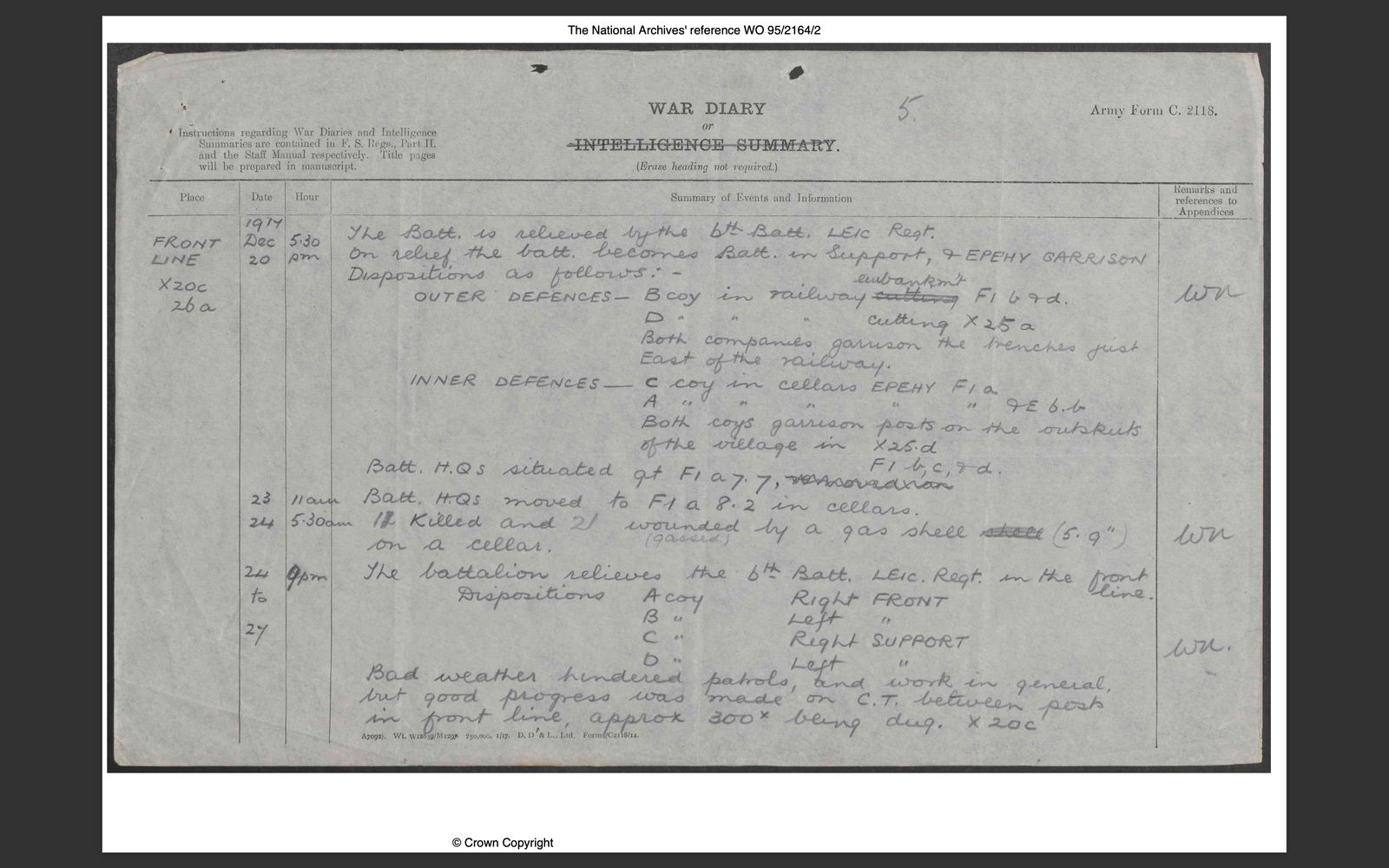
At 5.30 p.m. on 20 December they came out into support as the Épehy garrison. “C” Company took up quarters in the cellars of Épehy, map square F1a, and on the 23rd battalion headquarters joined them underground. At 5.30 on the morning of the diary records a single line: “12 Killed and 21 wounded (gassed) by a gas shell (5.9”) on a cellar.” Gerald was one of the dead. He was nineteen. Neither the war diary nor Richardson’s history names the men or says more about the shell. The best picture of where they were sheltering comes from a 6th Battalion private, F.E. Pothecary, who arrived at Épehy a month later. He described dugouts thirty steps down, with a gas-proof chamber halfway, bunks of wire netting three tiers high, candlelight, and air that was always hot and stuffy. At the top stood a gas guard ready to beat a hanging shell case or whirl a rattle at the first smell of gas. A 5.9-inch gas shell that broke into a cellar like that gave the men below almost no chance. At 9 p.m. that evening the battalion went back into the front line. On 30 December, in reserve at Saulcourt, “The men have their Xmas dinner at 12.30 pm.”
7th Battalion war diary, 20–27 December 1917: the dispositions of the Épehy garrison, with “C” Coy in cellars, F1a.
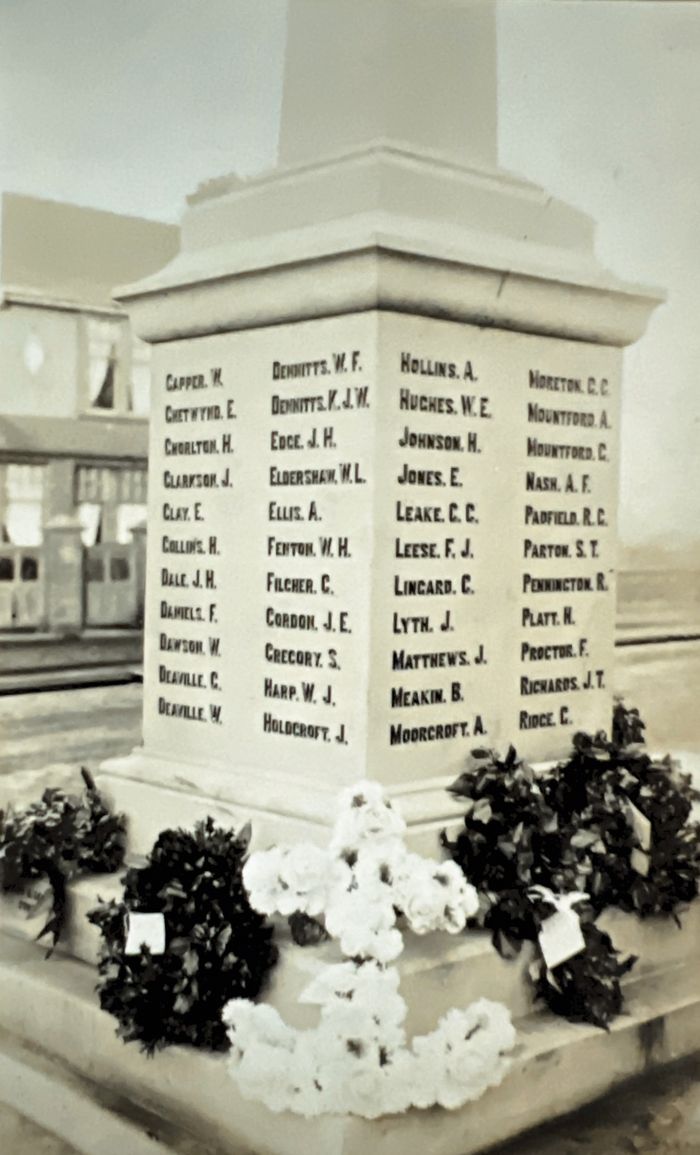
He is buried in Épehy Wood Farm Cemetery, grave III. D. 13, alongside comrades killed the same morning. The Commonwealth War Graves Commission record describes him as the son of Arthur Pollard Moreton and Mary Moreton, of 225 Werrington Road, Bucknall, born at Hanley. In April 1918 his belongings came home to his father from the infantry records office at Lichfield: “Letters, Wallet, Small Case, Photo, Card, Mirror in Case, Religious Book, Comb (broken).” Arthur Moreton signed for them on 24 April. In 1919 the family filled in the army’s form listing his living relatives, for the memorial plaque and scroll sent to the next of kin; under brothers and sisters they wrote “None”. At home, his name, MORETON G.C., was cut into the local war memorial.
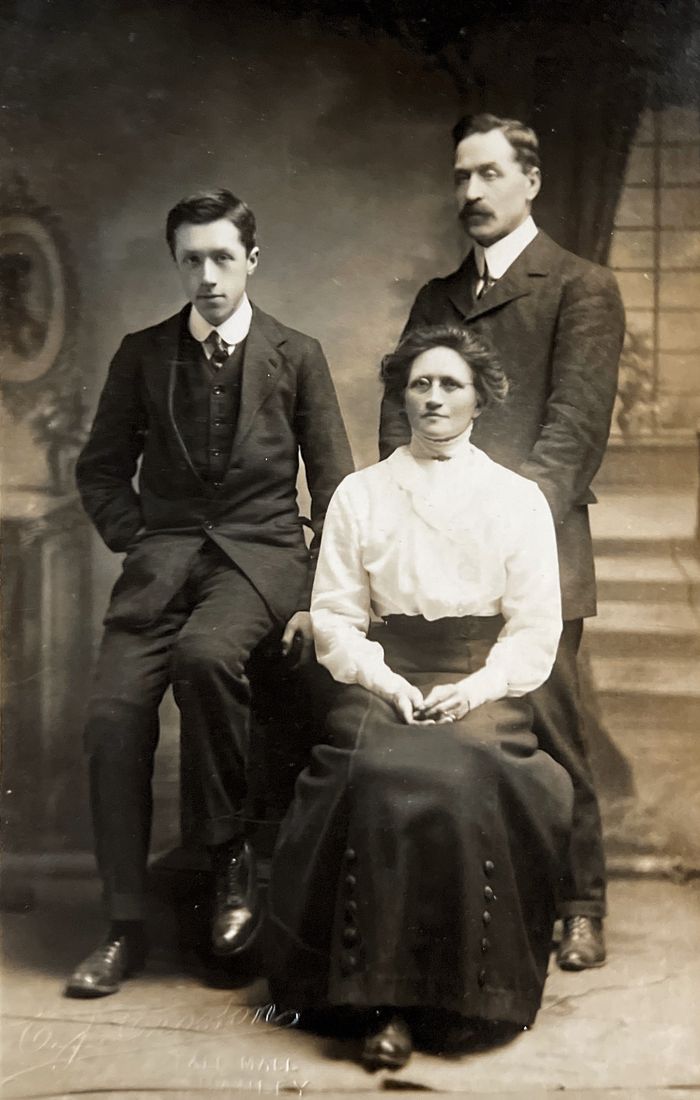
Arthur Pollard and Mary [Critchlow] Moreton with Gerald, aged 14, in 1912.The family’s photograph of the memorial; “MORETON G.C.” heads the right-hand column.
Three months later, on 21 March 1918, the German Spring Offensive broke over Épehy in thick fog. The 7th Leicesters held the left of the brigade front and kept one of the new concrete blockhouses, Morgan’s Post, for much of the day. At dawn on the 22nd the survivors were ordered to abandon the village. The ground where Gerald was buried stayed in German hands until it was retaken in September 1918.
The cousins were never in France at the same time. William had been sent home six months before Gerald crossed the Channel. But the ground they knew was close: Gommecourt, where William’s column hauled shells for a year, is less than 40 kilometres up the same front from the cellars at Épehy.
Side by side
The two service lives in parallel
Select any entry to jump the map to that day.
Corrections for the existing posts
What the records change
Volunteered “for the North Staffordshire Regiment of Artillery” on 1 November (the William post says 11 November) 1915.
Attested 1 November 1915 at Hanley as a Driver, 3/2nd North Midland Brigade RFA (Territorial Force). All three of his attestation papers carry that date.
Arrived at the Somme on 1 July 1916.
Landed in France 24 March 1916; joined the 5th Staffordshire Battery on 28 March; joined the 46th Divisional Ammunition Column on 26 June. “1 July 1916” is the date that move was reported.
Demobilised at Charlton.
Charlton S.E.7 was the Royal Horse and Royal Field Artillery records office that signed his papers. He left Ireland on 15 April 1919 and was formally disembodied on 15 May, at the end of his 28 days’ furlough.
Survived nearly 3½ years of trench warfare in the Somme.
About fourteen months in France (March 1916 to May 1917), then home service, mostly in Ireland, until May 1919.
After Field Punishment, posted to 325 Brigade.
Posted to Base as “Under Age” on 18 May 1917, sent to England, then posted to 325 Brigade (65th Division, Ireland) on 21 June 1917.
Wikipedia extracts on Hooge, Hohenzollern Redoubt and Egypt (1915).
All before William enlisted. Useful context for the brigade, but not his own experience.
Gerald listed among the 21 wounded; ten men killed.
The battalion diary records twelve killed and twenty-one gassed. Gerald was among the killed, and is buried at Épehy Wood Farm Cemetery (III. D. 13).
The battalion arrived at Épehy in mid-December.
It entrained at Savy on 30 November, detrained at Tincourt at 7 a.m. on 1 December, and was in the front line east of Épehy that night.
Still to find
Open questions
William’s leg wound. No wound, hospital admission or evacuation appears on the surviving forms, and a man evacuated wounded would normally show one. His June 1916 trip to base was a “nominal roll” posting, not a casualty evacuation. Three moments in the diaries fit a slight wound treated at duty: the shelling of his battery on 23 April 1916 (four killed, two wounded, by the 232 Brigade diary), though drivers were usually back at the wagon lines rather than at the guns; drivers “slightly wounded … whilst delivering ammunition” on 25 and 29 June 1916, and six of the column’s men wounded by shell fire on 6 May 1917, near Noeux-les-Mines, twelve days before he was sent home. The diary never names other ranks. The War Office daily casualty lists (printed in The Times, searchable in the British Newspaper Archive) for June–July 1916 and May–June 1917 would show “Critchlow, W.H., 1734” if he was wounded.
The “Under Age” file. DAG reference CR 5544/2014 and his conduct sheet would show whether the field punishment and his discovery were linked.
Where William was between May 1917 and Ireland. “To England” has a partly overwritten date, and the RFA reserve brigade he passed through is not named.
Eyewitnesses of 24 December 1917. Richardson names two 7th Battalion sources that may cover Christmas Eve: QMS Arthur Cave’s typescript diary (held privately by his family) and D.V. Kelly’s memoir 39 Months with the Tigers (1930), pp. 87–103. The Leicestershire Record Office holds the battalion papers and the Leicester Daily Mercury, which may have printed the casualty list.
Lt J.H. Harratt’s map. A 6th Battalion trench map annotated “Epehy Dec 1917” (pictured in The Tigers, credited to John Storey) is the only map known of the positions that month; it may show the cellars at F1a.
Which draft Gerald joined. The diary records drafts of 40 at Coupigny (22–24 November) and 94 at Frévillers (26–29 November). The nominal rolls, if they survive with the battalion’s papers at the Royal Leicestershire Regiment Museum, would settle it.